Let us get the question out of the way immediately: yes, creatine works for women. Not just a little — it works well, and for specific reasons Indian women benefit more from it than most other demographics in the world. The 'creatine is for men' idea is one of the more stubborn myths in Indian fitness culture, and it has no basis in science.
This guide is not going to tell you to take creatine and call it a day. It is going to explain exactly what creatine does in a woman's body, why the concerns most Indian women have about it are unfounded, what actually happens to your training when you use it correctly — and which products available on Amazon India are worth your money.
Top Creatine Products

✨ AI Summary
- ✓Yes, creatine works exactly as well for women as it does for men — the research is unambiguous
- ✓You will NOT get bulky — creatine does not change your hormone profile or accelerate muscle growth beyond your natural limit
- ✓Indian vegetarians benefit the most — your baseline creatine stores are 20–30% lower than meat-eaters
- ✓Dose: 3–5g per day. No loading phase needed. Take it every day including rest days
- ✓Best budget: AS-IT-IS Creatine 250g (Labdoor USA certified, ~₹507)
- ✓Best quality: Wellcore Creapure 250g (pharmaceutical-grade from Germany, ~₹999)
- ✓Most popular: MuscleBlaze Creatine 250g (Trustified by Eurofins, ~₹899)
- ✓Beyond strength: emerging research shows creatine benefits bone density, cognitive performance, and mood — all relevant to women specifically
The myth: 'creatine will make me look bulky'
This is the single biggest reason Indian women avoid creatine — and it is based on a misunderstanding of what creatine actually does. Creatine does not increase testosterone. It does not accelerate anabolic hormone activity. It does not change your body composition on its own. What it does is increase the water content inside your muscle cells and improve your ability to regenerate ATP (energy) rapidly during intense effort.
The initial 1–2 kg weight gain some people see when starting creatine is intracellular water — water stored inside the muscle cell itself, not subcutaneous water retention that makes you look puffy. This intracellular water actually makes muscles look slightly fuller and more defined — not bigger, not bloated. And for many women who take creatine without changing their training, the scale does not move at all.
The women in clinical creatine studies do not look like bodybuilders. They look like women who train hard. Creatine helps them train harder. That is the entirety of its effect on body composition.
Why Indian women have more to gain than most
Three specific factors make creatine particularly valuable for women in India:
1. Most Indian women are vegetarian
Dietary creatine comes almost entirely from red meat and fish. A typical Indian vegetarian diet — dal, sabzi, roti, dairy, occasionally eggs — provides essentially zero creatine. This means vegetarian women start with muscle creatine stores 20–30% lower than meat-eating women. The relative performance improvement from supplementation is therefore larger. Studies consistently show vegetarians gain more from creatine than omnivores — up to 20–25% improvement in high-intensity performance versus 10–15% in meat-eaters.
2. Indian women are chronically protein-deficient
A 2017 IMRB survey found that 73% of Indian women consume less than half the recommended daily protein intake. Creatine does not replace protein, but it makes every gram of protein you do eat more effective — by improving training performance, which is the stimulus that makes protein synthesis actually happen. Better training stimulus + adequate protein = better results from the same effort.
3. Bone density becomes critical after 30

Affiliate link: we may earn a small commission if you buy through it, at no extra cost to you.
Indian women lose bone density faster than Western women after menopause due to lower baseline calcium stores and Vitamin D deficiency. Creatine supplementation has been shown in multiple trials to slow bone loss in postmenopausal women when combined with resistance training — more than resistance training alone. This is an underreported benefit that has nothing to do with aesthetics and everything to do with long-term health.
Research: Creatine does not affect endogenous testosterone, LH, or FSH levels in women. A 2021 review of 10 randomised controlled trials found zero significant changes to female hormone profiles from creatine supplementation at standard doses.
What creatine actually does for you — the honest version
Your muscles store phosphocreatine. When you do any explosive or high-intensity movement — the last 3 reps of a set, a sprint, a jump — your body burns through ATP (energy) faster than it can be replenished through aerobic metabolism. Phosphocreatine donates its phosphate group to regenerate ATP almost instantly. More stored creatine = faster ATP regeneration = you can do one or two more reps before failure, lift slightly heavier, or recover slightly faster between sets.
Over months, those extra reps compound. You get stronger, your muscles respond to a stronger stimulus, and your training output genuinely improves. It is not magic. It is one extra rep per set, across every set, across every session, across every week for years. That compounds into something real.
- Strength gains: Multiple meta-analyses confirm 5–15% improvement in strength outcomes over training alone
- Lean mass: 1–2 kg more lean mass over 12 weeks compared to training without creatine
- Fatigue resistance: More reps at the same weight before failure — the most practically useful benefit
- Cognitive performance: Emerging research shows meaningful benefits to working memory and processing speed, particularly under sleep deprivation — relevant to working women
- Bone density: Particularly in postmenopausal women doing resistance training — slows bone loss measurably
- Mood and depression: Small trials show creatine may benefit depressive symptoms in women, possibly via brain energy metabolism
How to take it — the simple version
- Dose: 3–5g per day. Most women find 3g sufficient; 5g is the standard used in most research
- Timing: Post-workout on training days, with breakfast on rest days — consistency across all days matters more than exact timing
- No loading phase needed: It takes 3–4 weeks to fully saturate at 5g/day vs 1 week with loading (20g/day). The loading protocol is unnecessary and causes GI discomfort
- No cycling needed: Take it every day, year-round. There is no evidence that cycling provides any benefit
- Water: Drink at least 3–3.5 litres of water per day when using creatine — this supports the intracellular hydration effect
- With food or without: Does not matter. Mix into a protein shake, yoghurt, or any warm liquid — creatine dissolves easily in warm water
PCOS and creatine: Early research suggests creatine may be beneficial for women with PCOS due to its effects on insulin sensitivity and cellular energy. This is still emerging evidence — but there is no known reason to avoid creatine if you have PCOS, and some reason to think it may be helpful.
Best creatine products in India for women 2026
All creatine monohydrate is 100% vegetarian — it is synthesised chemically and contains no animal tissue. Look for a third-party lab certificate and FSSAI registration on the label. These are the best options on Amazon India right now:
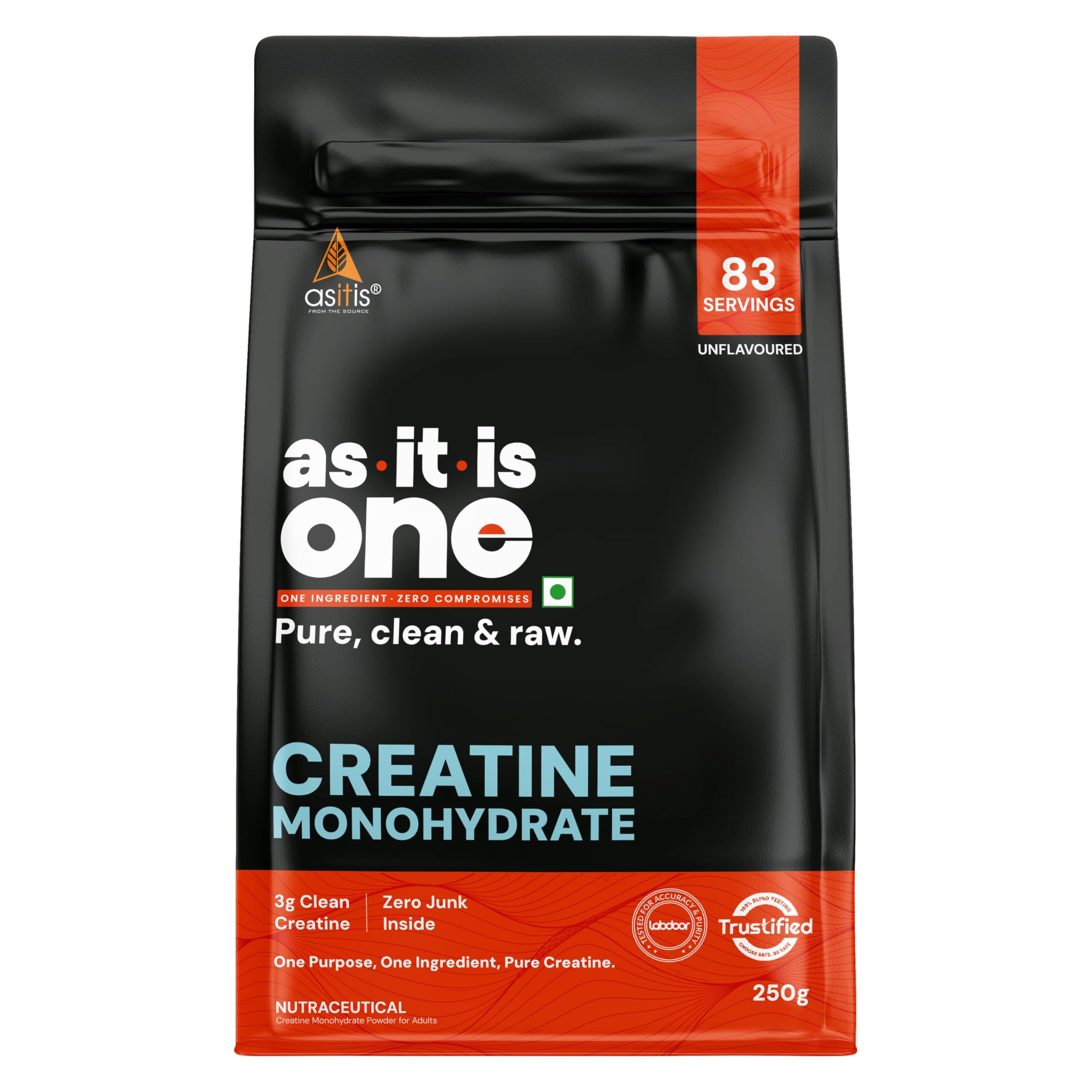
AS-IT-IS ONE Creatine Monohydrate 250g — Best Budget
Unflavoured · 250g
- 3g creatine / serving
- Lab tested by Labdoor
- 4.2★ rated
The default recommendation for most Indian women starting creatine. Labdoor USA certified — one of only two Indian creatine brands with international third-party testing. 50 servings at 5g daily. Zero taste, zero additives, mixes cleanly in anything warm. At ~₹507 for 250g, the cost works out to roughly ₹10 per day — less than a cup of chai.
- Price: ~₹507 for 250g (50 servings at 5g, or 83 servings at 3g)
- Certification: Labdoor USA — tests for amino spiking and purity independently
- Purity: 99.9% creatine monohydrate, zero fillers
- Best for: First-time creatine users, budget-conscious buyers, vegetarians
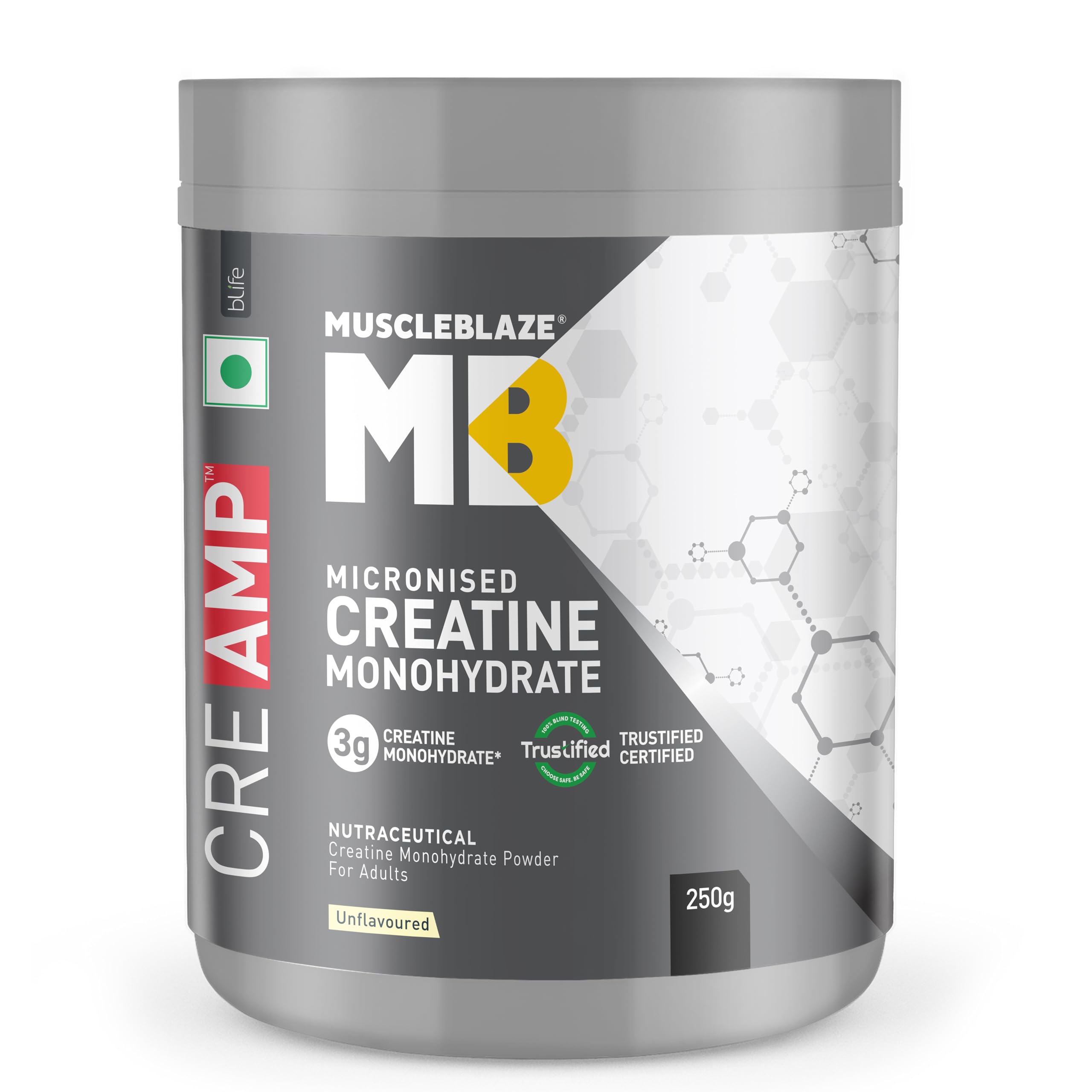
MuscleBlaze Creatine Monohydrate 250g — Most Popular
Unflavoured · 250g
- 3g creatine / serving
- Lab tested by Trustified
- 4.2★ rated
India's highest-selling creatine brand, Trustified by Eurofins laboratory with batch-level QR codes you can scan to verify. Available from MuscleBlaze's official Amazon store — important for authenticity given rampant supplement counterfeiting in India. The micronized form dissolves better than coarser powders. At ~₹899 for 250g, marginally pricier than AS-IT-IS but with broader retail availability and stronger brand documentation.
- Price: ~₹899 for 250g (50 servings at 5g)
- Certification: Trustified by Eurofins India
- Form: Micronized for better dissolution
- Best for: Brand-trust buyers, those who want widest availability and the most recognisable Indian supplement brand
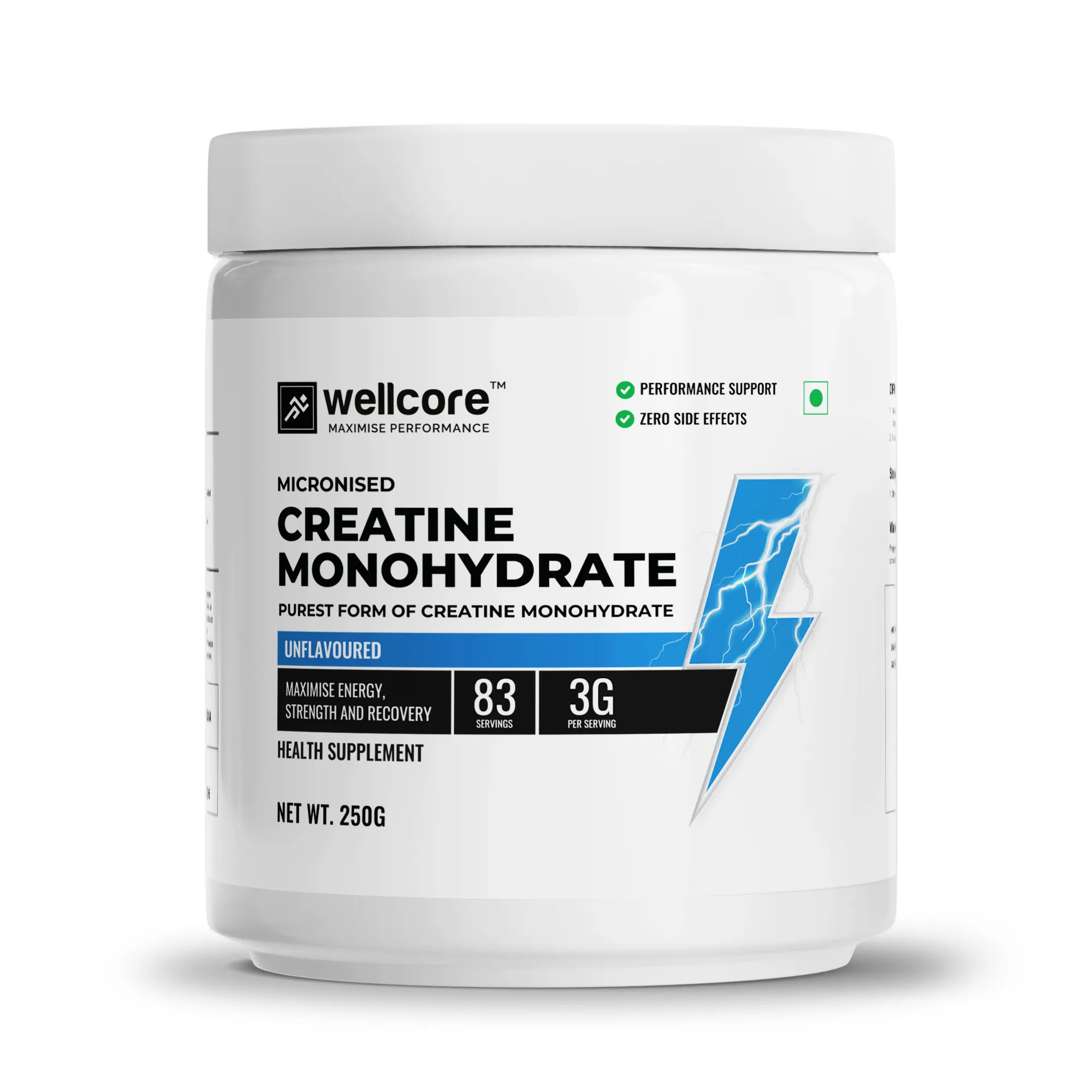
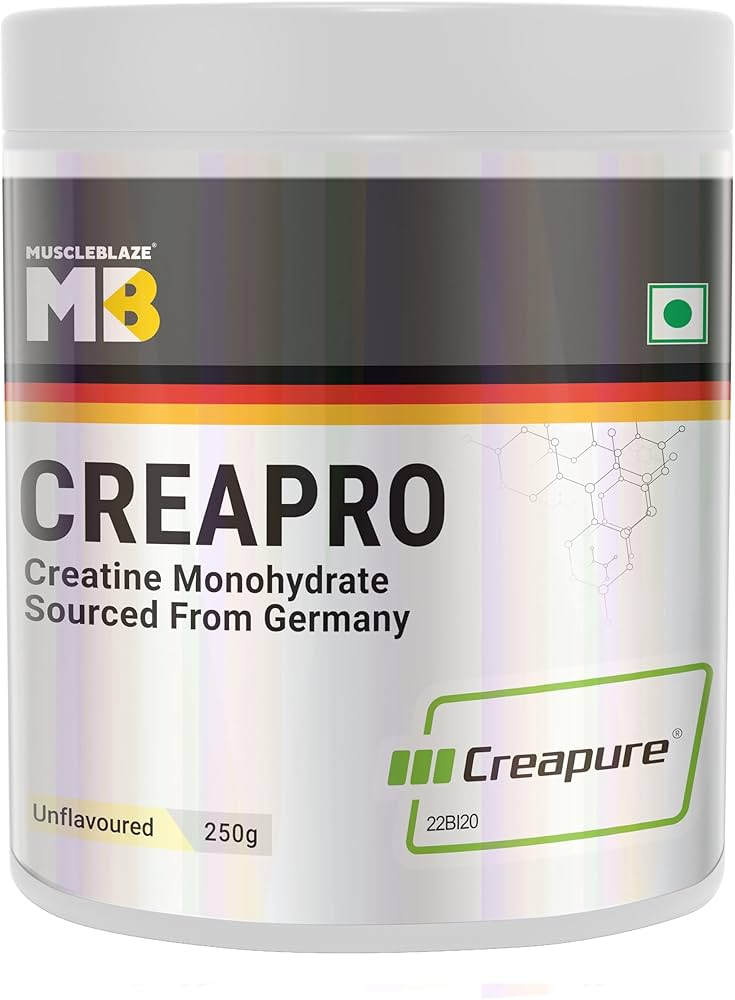
Wellcore Micronized Creatine 250g — Best Quality
Unflavoured · 250g
- 3g creatine / serving
- Lab tested by Trustified
- 4.4★ rated
Wellcore uses Creapure — the pharmaceutical-grade creatine manufactured by AlzChem in Germany. Creapure is the original creatine source used in most clinical research and guarantees 99.99% purity with independent testing for contaminants (DCD, DHT, dicyandiamide) that generic creatine may contain. At ~₹999 for 250g, it is only ₹100–200 more than generic options. If you want the highest-purity option available in India, this is it.
- Price: ~₹999 for 250g (50 servings at 5g)
- Source: Creapure from AlzChem Germany — pharmaceutical-grade
- Purity: 99.99% — the highest available in India
- Best for: Quality-first buyers, those who want the same grade used in clinical research
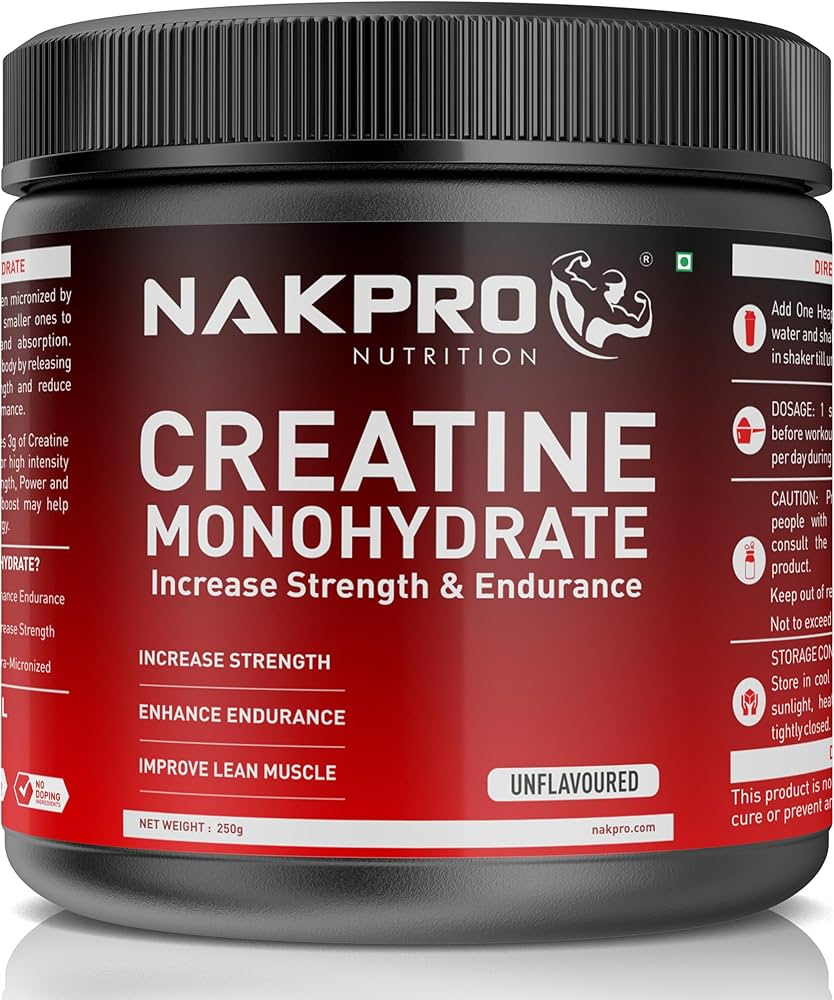
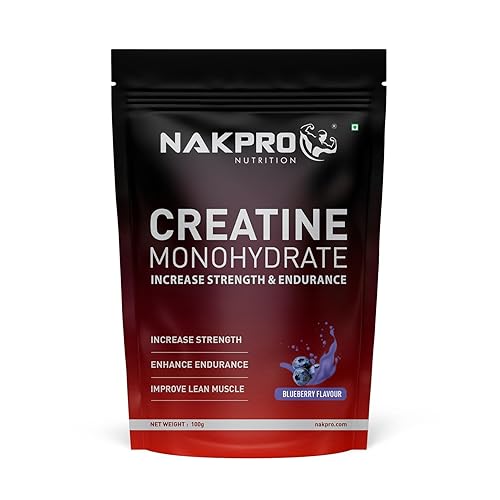
Nakpro Creatine Monohydrate 250g — Best Value
Unflavoured · 250g
- 3g creatine / serving
- Lab tested by Trustified
- 4.2★ rated
Bengaluru-based brand with consistent Amazon ratings and Trustified certification. At ~₹493 for 250g, Nakpro consistently offers the lowest per-serving price among certified Indian creatine brands. 50 servings, unflavoured, FSSAI certified. The value case is hard to argue with — lab-tested creatine at under ₹10 per day.
- Price: ~₹493 for 250g — lowest certified per-serving price in India
- Certification: Trustified
- Best for: Pure value buyers who want certified creatine at the lowest possible cost
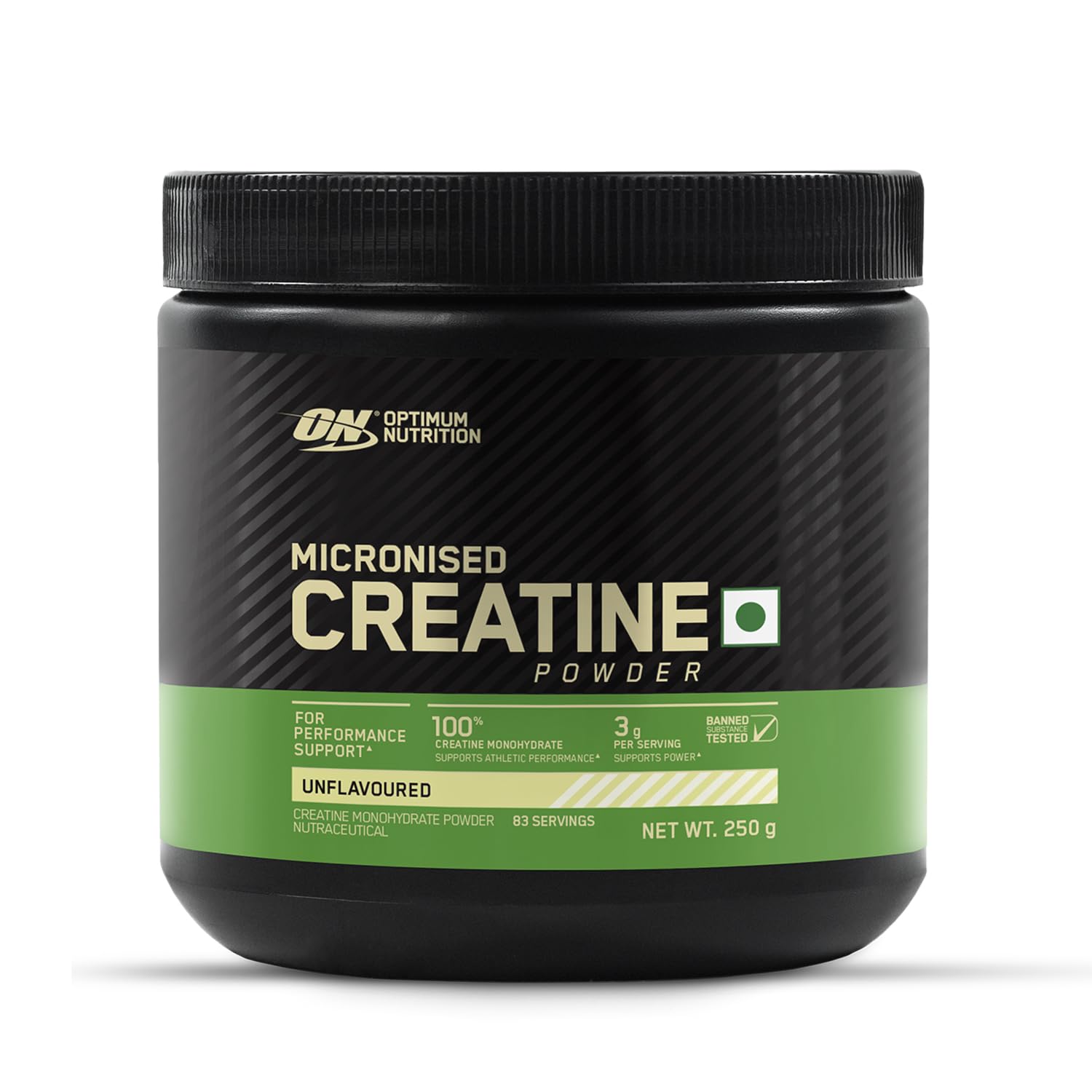
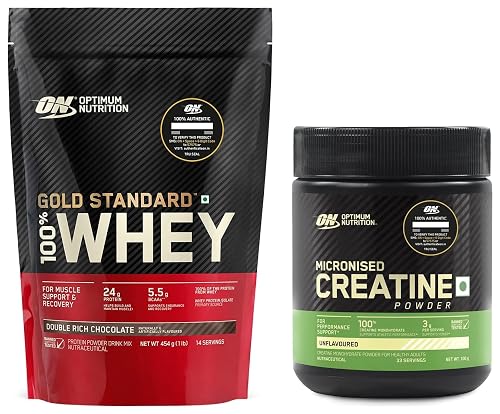
ON Micronized Creatine 250g — Best International
Unflavoured · 250g
- 3g creatine / serving
- Lab tested by Informed Choice
- 4.3★ rated
Optimum Nutrition's creatine is Informed Sport certified — the anti-doping standard used by competitive athletes in tested sports. At ~₹889 for 250g, it is competitively priced against Indian alternatives. The only reason to choose ON over the Indian options is if you need Informed Sport certification specifically — which matters for competitive athletes. For recreational gym-goers, AS-IT-IS or Wellcore deliver equivalent quality at a similar or lower price.
- Price: ~₹889 for 250g (50 servings at 5g)
- Certification: Informed Sport — the anti-doping standard for competitive athletes
- Best for: Competitive athletes in tested sports, brand-conscious international buyers
Common questions Indian women ask about creatine
Will creatine affect my periods or hormones?
No. Multiple controlled trials have specifically tested this. Creatine supplementation at standard doses (3–5g/day) does not alter oestrogen, progesterone, testosterone, LH, or FSH in women. It has no interaction with the hormonal systems that govern the menstrual cycle. If anything, the mood and brain energy benefits may reduce PMS-related symptoms — this is an area of active research.
Is creatine safe to take during pregnancy?
This is one area where the evidence is genuinely incomplete. Animal studies are very promising — creatine appears to be protective for the developing foetus — but there are no large-scale human trials. Standard guidance is to consult your doctor before supplementing with anything during pregnancy. Creatine is not on any prohibited list, but without human trial data, specific advice on this falls outside what WheySearch recommends.
I am 40+ and not a serious gym-goer. Is creatine still worth it?
Potentially more so. Muscle creatine stores decline with age. After 40, women lose 3–8% of muscle mass per decade (sarcopenia), and this accelerates after menopause. Creatine supplementation combined with any resistance exercise — even bodyweight training at home — has been shown to significantly slow sarcopenia and preserve strength in older women. The bone density data is also specifically strongest in this age group. You do not need to be a serious gym-goer for creatine to have value.
Does creatine cause hair loss?
This concern comes from a single 2009 study on rugby players that found creatine loading increased DHT (dihydrotestosterone) levels — a hormone linked to hair loss. The study has significant limitations: it was a loading protocol, it was on men, and DHT levels returned to baseline after the loading phase. No subsequent study has replicated this finding. Multiple long-term creatine trials show no effect on hair health in either sex. The hair loss concern is not supported by the current evidence.
Can I take creatine with whey protein?
Yes — and this is actually ideal. Taking creatine with a post-workout protein shake combines two of the most evidence-backed supplements at the optimal time. The carbohydrates often present in protein shakes may slightly improve creatine uptake. There is no negative interaction between creatine and whey protein.
All creatine monohydrate is 100% vegetarian. It is synthesised chemically from sarcosine and cyanamide — no animal tissue is involved at any stage. Look for the FSSAI green dot on the label to confirm vegetarian certification on the specific product you buy.
The bottom line
Creatine is one of the most thoroughly researched supplements in existence. It works. It is safe. It is cheap. The 'only for men' belief has no scientific basis — if anything, Indian vegetarian women are among the people most likely to benefit from it given their significantly lower baseline creatine stores.
Start with AS-IT-IS or Nakpro for the most cost-effective certified entry point. Upgrade to Wellcore Creapure if you want pharmaceutical-grade purity. Take 3–5g daily, every day, mixed into anything you are already drinking. Give it 4–6 weeks before evaluating results. That is it.